
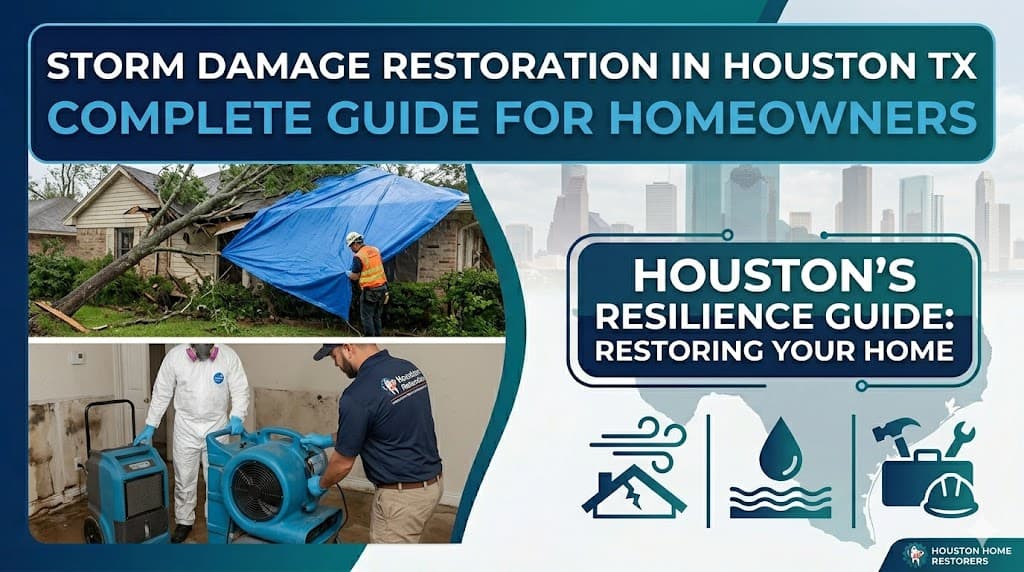
Texas is in the middle of one of the most active severe weather stretches in years. Supercell thunderstorms have produced golf-ball and baseball-size hail across the Plains, Hill Country, and Gulf Coast — with additional rounds of severe weather forecast through the rest of April and into peak storm season. If your property was just hit, the next 30 days matter more than the storm itself. What most Texas homeowners miss: the real financial damage from hail is rarely the roof itself — it is the water, mold, and interior damage that follow when hail-compromised roofing and siding let moisture into the home.
This guide is written for Texas homeowners who need answers after the hail. We cover how to identify damage that is invisible from the ground, how to stop water from entering your home immediately with emergency tarping and board-up, the exact Texas insurance rules that control your claim (including the 1-year deadline under §542A and the 1–5% wind/hail deductible most homeowners did not know they had), and what a professional hail and storm damage restoration process actually looks like from emergency mitigation to full interior rebuild.
Important context: LPR Mitigation Services is a licensed Texas restoration and mitigation company — not a roofing contractor. We handle the damage roofers do not: emergency tarping, water extraction, structural drying, mold remediation, and interior reconstruction. We coordinate with your roofer (or help you find a reputable one) and work directly with your insurance adjuster so the full scope of hail damage — not just the obvious roof portion — is documented and covered.
Why speed matters after a Texas hail storm
Insurance carriers argue hardest against claims filed more than 30–60 days after the event. Roof leaks triggered by hail often do not appear until the next heavy rain — by then, interior drywall and mold damage is already stacking up, and your adjuster may blame it on "wear and tear" instead of the storm. File fast, document everything, and get a certified inspection within the first two weeks.
Why Texas Gets Hit So Hard by Hail
Texas sits at the southern edge of what insurance carriers informally call "Hail Alley" — the corridor stretching from the Dakotas down through Oklahoma and Texas where warm, moist Gulf air collides with cold continental air over the Plains. This collision fuels the supercell thunderstorms that produce large, destructive hail. According to National Insurance Crime Bureau data, Texas consistently ranks #1 or #2 in the United States for total hail loss claims, year after year.
The 2026 severe weather season is shaping up to be one of the more active in recent memory. Major hail events have already swept the Midwest and Plains, with multiple rounds of large hail reported across North Texas, the Hill Country, and the Houston metro. Additional severe thunderstorms are forecast across the state through May and June.
For Texas homeowners, the pattern repeats every spring: a fast-moving supercell dumps 1- to 3-inch hail over a neighborhood in 15 minutes, the homeowner looks at the roof from the front yard, sees no obvious holes, and assumes everything is fine. Six months later, the first hard rain triggers ceiling leaks, the roof begins failing prematurely, and the insurance claim window has closed.
What Size Hail Damages a Texas Roof?
Hail size is the single strongest predictor of roof and property damage. The National Weather Service classifies any hail 1 inch or larger as "severe," and 1 inch is roughly the threshold at which modern asphalt shingles begin sustaining functional damage. Here is how hail size correlates with typical damage to a Texas home.
| Hail Size | Common Reference | Typical Damage |
|---|---|---|
| 0.5" – 0.75" | Pea to penny | Minor cosmetic damage to soft metals, window screens, painted surfaces |
| 1.0" – 1.25" | Quarter to half-dollar | Functional roof damage begins. Shingle granule loss, bruising, dented gutters and flashing |
| 1.5" – 1.75" | Ping-pong to golf ball | Cracked shingles, damaged vents and turbines, dented HVAC fins, siding dents |
| 2.0" – 2.5" | Tennis ball to baseball | Shingle punctures, shattered skylights, broken windows, cracked siding panels |
| 2.75"+ | Softball and larger | Catastrophic. Full roof replacement, structural damage, totaled vehicles and HVAC |
Even if you did not see the hail yourself, you can estimate the size using the National Weather Service local storm reports for your county or by checking hail swath maps from weather data providers. Save screenshots — this is strong supporting evidence for your insurance claim.
10 Signs of Hail Damage on Your Texas Home (Most Are Invisible From the Ground)
The single biggest mistake Texas homeowners make is walking around the yard, seeing no gaping holes, and assuming the storm passed without damage. Modern asphalt shingles often mask hail impact. Siding, gutters, and HVAC units tell the real story — and so does the roof, but only under close inspection. Before you climb up, check the ground-level evidence first.
1. Granule Loss in Gutters and Downspouts
Look in your gutters, at the base of downspouts, and on the ground below the eaves. A pile of black sand-like granules after a hail storm is the clearest indicator of shingle damage. Asphalt shingles rely on their granule layer for UV protection — once granules are knocked loose, the underlying asphalt mat degrades rapidly and the shingle fails years ahead of schedule.
2. Dents on Gutters, Downspouts, and Fascia
Aluminum gutters are soft and show hail impact clearly. Even on the side of the home where the storm did not appear severe, run your hand along the top rim of the gutter. Dents the size and shape of a quarter or larger are evidence of damaging hail.
3. Damaged HVAC Condenser Fins
Walk around your outdoor AC unit. The aluminum fins on the condenser coil are one of the most sensitive hail damage indicators in existence — they will show impacts from hail as small as ¾ inch. Flattened or folded fins not only prove the storm was severe, they also reduce the cooling capacity of your system and are typically covered by your homeowner policy.
4. Torn or Punctured Window Screens
Window screens are soft-metal mesh and tear easily. Hail-driven tears are concentrated on the wind-facing side of the home and typically appear as small punctures rather than long rips.
5. Cracked or Split Siding Panels
Vinyl siding is especially prone to hail cracking on its south and west exposures in Texas, where UV exposure makes the panels brittle. Check for hairline cracks, chipped paint, and oval dents under raking morning or evening light.
6. Broken or Chipped Roof Vents and Turbines
Plastic attic vents, turbine vents, and satellite dish mounts crack under hail impact. Broken vents create a direct water intrusion path into your attic and must be documented and replaced promptly.
7. Dented Garage Doors and Overhead Panels
Metal garage doors take hail impacts that reveal the storm's severity. Dents on the upper panels in particular indicate near-vertical hail fall — which is the angle that damages roofing.
8. Circular Bruises on Shingles (Roof Inspection)
On the roof itself, hail damage typically appears as dark circular "bruises" ½ inch to 1½ inches across, where the granule layer has been driven into the asphalt mat. Running a finger across the bruise, the asphalt feels soft and pliable compared to the firm feel of undamaged shingle. A trained inspector uses chalk or spray paint to mark impacts and photographs them for the claim file.
9. Cracked or Shattered Skylights and Solar Panels
Skylights and rooftop solar arrays are high-value items that are fully covered by homeowner insurance when hail-damaged. Skylight glass often develops radial cracks that are not obvious from inside the home — inspect from the roof or with a drone.
10. New Interior Leaks or Stains (Days or Weeks Later)
After a hail event, watch your ceilings and upper walls for water staining during the next 2–3 rain events. A leak that appears within 30 days of the storm is almost always hail-caused and should be documented immediately with photographs before patching. Delayed leaks are a leading source of water damage and mold growth inside Texas homes.
What to Do in the First 72 Hours After a Texas Hail Storm
The window immediately after a hail event is where most insurance claims are won or lost. Follow these steps in order.
Step 1: Document Before You Clean Up
Walk the exterior of your property and take time-stamped photographs and video from every side. Capture wide shots showing the overall property, medium shots of each damaged area, and close-ups of specific damage with a coin or ruler for scale. Photograph the hail itself if it is still on the ground, and save National Weather Service reports and any doorbell or security camera footage of the storm. This raw documentation is the backbone of your claim.
Step 2: Do Not Climb the Roof Yourself
Wet, hail-damaged roofs are slippery and structurally compromised. Homeowner falls after storms send thousands of people to Texas emergency rooms every spring. Let a licensed, insured professional perform the inspection. A free post-storm inspection from a restoration or mitigation company typically takes 30–60 minutes and produces the photographic documentation your adjuster needs — without the conflict of interest that comes with a roofer who only gets paid if they sell you a new roof.
Step 3: Temporarily Protect Interior From Water
If a skylight cracked or shingles are clearly missing, put buckets under any drips, move furniture and electronics out of the affected area, and arrange professional emergency tarping or board-up. Your policy requires you to take reasonable steps to prevent further damage and reimburses the cost of doing so — keep all receipts.
Step 4: Get an Independent Professional Inspection
Schedule a hail damage inspection with a Texas-licensed restoration and mitigation company before the insurance adjuster arrives if possible. Unlike a roofer, a mitigation company inspects the full property — roof, attic, interior ceilings and walls, HVAC, and moisture conditions — and has no financial incentive to oversell roof repair. An experienced inspector identifies damage the adjuster might miss, documents it in the format carriers expect, and provides a written scope of loss. Most adjusters spend 30 minutes on-site; a thorough restoration inspection takes 2 hours or more.
Step 5: File Your Claim With the Insurance Carrier
Call your insurance carrier's claims line and report the date of loss, type of loss (hail), and a brief description of visible damage. Get the claim number in writing, ask who your assigned adjuster will be, and confirm in writing the deductible that applies to wind and hail claims. Do not minimize the damage on this call — the carrier will use your initial description to scope the claim.
Step 6: Meet the Adjuster With Your Documentation in Hand
When the adjuster arrives, hand them a documentation package: your photos and video, the inspector's report, National Weather Service storm reports, and a written list of damaged items. Walk the property with the adjuster and point out every damaged area. Do not sign any document on the spot beyond acknowledging the adjuster's visit — scope and estimates can be negotiated later.
Texas Hail Insurance Claims: What Most Homeowners Do Not Know
Texas is one of the most hail-active states in the nation, and the insurance industry has responded by writing Texas-specific policy terms that differ significantly from other states. Understanding these terms before you file is critical.
The 1% to 5% Wind and Hail Deductible
Most Texas homeowner policies carry a separate, percentage-based wind and hail deductible — typically 1% to 5% of the Coverage A (dwelling) amount. On a home insured for $400,000, a 2% wind/hail deductible is $8,000 out of pocket before insurance pays anything on a hail claim. This is not the same as the flat dollar deductible that applies to fire or theft. Coastal counties served by the Texas Windstorm Insurance Association (TWIA) often carry even higher percentage deductibles. Check your policy declarations page so you are not surprised when the settlement arrives.
The 1-Year Filing Deadline Under Texas Insurance Code §542A
Texas law requires you to give notice of a weather-related insurance claim within one year of the date of loss unless your policy specifies a longer period. File later than that and the carrier has a statutory basis to deny coverage. Your specific policy may impose a shorter deadline — many Texas policies now include "prompt notice" language requiring notice within 30, 60, or 90 days. Read your policy and file early.
Actual Cash Value vs. Replacement Cost
Many Texas roof endorsements pay Actual Cash Value (ACV) — replacement cost minus depreciation based on the age of the roof — rather than full Replacement Cost Value (RCV). On a 15-year-old roof, this can cut the settlement in half. Other policies pay RCV but only once the roof is actually replaced and final invoices are submitted. Know which you have before you budget the repair.
Matching and Code Upgrade Coverage
If only one slope of your roof is damaged, your policy may or may not pay for matching shingles across the entire roof. Texas case law on "matching" is complex. Additionally, "Ordinance or Law" endorsements cover the cost of upgrading to meet current building code — important because Texas roofing code now requires ice-and-water shield in valleys and upgraded underlayment that older roofs do not have. Ask your agent whether your policy includes code upgrade coverage.
Texas insurance fact most homeowners miss
Under Texas Insurance Code §27.02, it is illegal for a roofer or contractor to offer to pay, waive, absorb, or rebate your insurance deductible. If a contractor says "we'll cover your deductible," they are asking you to participate in insurance fraud. Walk away.
Why Call a Mitigation Company Before a Roofer After Hail
The instinct after a hail storm is to call a roofer first. That is usually the wrong order of operations — and it is the single most common mistake that costs Texas homeowners thousands of dollars in denied or reduced insurance claims. A mitigation and restoration company should be the first professional on the property for five specific reasons.
1. No Conflict of Interest in the Damage Assessment
A roofer only makes money if they sell you a new roof. A mitigation company has no shingles to sell. When we inspect your property, we have no financial incentive to overstate — or understate — roof damage. Our inspection documents what the storm actually did: roof impacts, water intrusion paths, interior moisture, HVAC damage, and mold risk. This objective documentation carries more weight with insurance adjusters than a roofer's estimate, and it protects you if the carrier pushes back on scope.
2. Stopping the Water Is More Urgent Than Replacing the Roof
A new roof takes days to weeks to install — permits, insurance approval, material delivery, crew scheduling. In the meantime, every rain event drives more water through your hail-compromised roofing into the attic and interior. Emergency tarping installed within 24 hours of the hail event is what prevents the $5,000 claim from becoming a $30,000 claim. Roofers generally do not tarp; mitigation companies do.
3. Texas Humidity Means Mold Starts Within 48 to 72 Hours
If hail created any roof opening and water has entered the attic or ceiling cavity, mold colonization begins within 48 to 72 hours in Texas conditions. By the time the roofer has finished the tear-off and reroof 2 to 3 weeks later, mold is already established inside wall cavities and attic insulation. A mitigation company dries the structure and treats for microbial growth before the new roof goes on, eliminating a problem that is far more expensive to fix later. See mold remediation.
4. Insurance Documents the Full Scope, Not Just the Roof
Homeowners whose first professional contact is a roofer typically end up with a claim that covers the roof and nothing else — because the roofer only documented the roof. When the homeowner later discovers water-stained ceilings, soaked insulation, warped floors, or a moldy attic, they file a supplemental claim that the carrier often challenges or denies as "unrelated." A mitigation company documents the full interior and exterior scope in a single inspection, submitted to the adjuster as one integrated claim. Our insurance claims assistance team does this at no added cost.
5. You Avoid the High-Pressure Storm-Chaser Pipeline
When a homeowner puts "roofer near me" into Google the day after a hail storm, they land in a digital ad funnel dominated by storm-chaser lead-gen companies, not local Texas roofers. Calling a locally-based mitigation company first breaks that pipeline. We handle stabilization, documentation, and insurance — then you can take your time selecting a reputable Texas roofing contractor (we can recommend vetted local options we have worked alongside on prior claims) without pressure.
The correct post-hail call order for Texas homeowners
1. Mitigation company (free inspection, emergency tarping, documentation) → 2. Your insurance carrier (open the claim) → 3. Insurance adjuster visit (with your mitigation company's documentation in hand) → 4. Licensed Texas roofing contractor (for roof replacement once scope is approved) → 5. Mitigation company again for interior water, mold, and reconstruction work.
Watch Out for Storm-Chaser Roofers in Texas
Every major Texas hail event is followed within 48 hours by an influx of out-of-state roofing crews, door knockers, and "free inspectors" who target damaged neighborhoods, sign as many homeowners as possible, pocket insurance checks, do substandard roof work, and disappear before warranty issues surface. The Texas Department of Insurance and Attorney General's office receive thousands of hail-fraud complaints every year. A legitimate, locally-based mitigation and restoration company is often the first professional a homeowner should call after hail — because we can document the full scope of damage objectively, before any roofer quotes the job, and stabilize the property so water damage does not compound while you vet contractors.
Red Flags of a Storm-Chaser Roofer
- Door-to-door solicitation within days of the storm. Legitimate local contractors are overwhelmed with inbound calls — they are not knocking on doors.
- Out-of-state license plates or a rental truck. Check the company address — if it is in another state, they are a storm chaser by definition.
- Pressure to sign immediately "before the insurance adjuster gets here" or "before prices go up."
- Offer to pay, waive, or absorb your deductible. This is illegal in Texas under §27.02.
- Asking you to sign an Assignment of Benefits (AOB) that transfers your insurance claim rights to them. Never sign an AOB.
- No Texas Secretary of State registration or proof of general liability and workers' comp insurance specific to Texas operations.
- No physical office you can visit in Texas or only a PO Box.
- Ambiguous contract language that makes the work "contingent on insurance approval" without a clear scope, price, or completion date.
How to Verify a Legitimate Texas Contractor (Restoration or Roofing)
- Check the company's Texas Secretary of State filing and verify the address is a real office.
- For restoration companies, ask for the IICRC (Institute of Inspection, Cleaning and Restoration Certification) certification number and verify it.
- For roofing contractors, verify registration with the Roofing Contractors Association of Texas (RCAT) or manufacturer certifications (GAF Master Elite, CertainTeed SELECT ShingleMaster, Owens Corning Platinum).
- Request 3–5 local references from Texas homeowners within the past 12 months and call them.
- Verify general liability insurance and workers' compensation coverage by calling the insurance carrier directly, not just reviewing a certificate.
- Check Better Business Bureau records, Google reviews with photos, and Texas Attorney General complaint history.
- Confirm they will pull Texas building permits where required — storm chasers skip permits.
- Use your 3-day right of rescission under Texas Business and Commerce Code §601 if you already signed something under pressure.
Why homeowners call a mitigation company before a roofer
A mitigation and restoration company has no incentive to exaggerate roof damage — we do not sell roofs. We document damage objectively for your insurance claim, stop further water intrusion with tarping, and handle the water, mold, and interior work your roofer cannot. Then you can hire a vetted roofer without being pressured by whoever showed up first at your door.
The Hail Damage Restoration Process: What Mitigation Companies Actually Do
Most Texas homeowners think a hail claim means "call a roofer, get a new roof, done." That misses 60% of the work. Hail rarely causes only exterior damage — the impacts that compromise roofing, skylights, and siding create water intrusion paths that continue damaging the home's interior for weeks and months afterward. A restoration and mitigation company handles the damage a roofer cannot: stopping the water, drying the structure, preventing mold, and rebuilding the interior. Here is what a full-scope hail damage restoration looks like.
1. Emergency Tarping and Board-Up (First 24 Hours)
Before anything else, the building envelope must be sealed against further water entry. Professional mitigation crews install heavy-duty tarping over compromised roofing sections, board up broken skylights and windows, and seal any openings caused by hail impact. This work is explicitly required under your insurance policy's "duty to mitigate" clause and is fully reimbursable — keep every receipt. See 24/7 emergency board-up and tarping.
2. Full-Property Damage Assessment and Scope Development
A certified restoration inspector documents every affected area — not just the obvious roof damage. That includes moisture mapping of the attic, ceilings, and upper walls with thermal imaging and moisture meters; inspection of siding, windows, skylights, and HVAC condensers; and identification of interior water staining and hidden moisture. The result is a written, photograph-supported scope of loss that is submitted to your insurance carrier — far more detailed than what an adjuster or roofer produces on their own.
3. Water Extraction and Structural Drying
If hail-caused roof leaks allowed water into the attic, insulation, ceiling cavities, or interior walls, standing water is extracted and commercial-grade dehumidifiers and air movers are deployed. Drying equipment typically runs for 3 to 7 days with daily moisture readings documented for the insurance file. Skipping or shortcutting this step is the #1 cause of post-storm mold claims in Texas homes. See dehumidification and structural drying and water damage restoration.
4. Mold Prevention and Remediation
Texas humidity means mold can begin growing within 48 to 72 hours of a hail-caused leak. Mitigation includes antimicrobial treatment of exposed framing and subfloor, air quality testing when microbial growth is suspected, and full mold remediation under IICRC S520 standards if active mold is found — containment, HEPA filtration, contaminated material removal, and post-remediation clearance testing. Addressing mold during mitigation is dramatically cheaper than discovering it after the interior is rebuilt.
5. Insurance Claim Coordination
The restoration company works directly with your adjuster throughout, providing documentation, supplemental scope items the adjuster missed, and line-item estimates in the format carriers expect. Our insurance claims assistance team does this at no additional cost to the homeowner — it is built into the restoration engagement.
6. Coordination With Your Roofing Contractor
Full roof replacement is performed by a licensed Texas roofing contractor — not by a mitigation company. As your roof damage restoration partner, we sequence the roofer's work around interior mitigation so the building is dried and protected first, then the new roof goes on, then interior rebuild begins. If you do not have a roofer, we can refer you to vetted local Texas contractors we have worked alongside on prior claims.
7. Interior Reconstruction
Once the structure is dry and the roof is sealed, interior reconstruction services begin: drywall replacement, ceiling repair, insulation reinstallation, flooring, trim, and paint. A full-service mitigation and reconstruction company handles this end-to-end so the homeowner does not have to coordinate multiple contractors.
8. Final Documentation and Insurance Closeout
The completed restoration is inspected against the original scope of loss and final photographs and invoices are submitted to the insurance carrier for release of any withheld depreciation on RCV policies. A written workmanship warranty on mitigation and reconstruction work is issued to the homeowner.
Just Got Hit by Hail? Get a Free Texas Hail Damage Inspection.
LPR Mitigation Services provides free, no-obligation hail damage inspections across Greater Houston. As a Texas-based mitigation and restoration company — not a roofer — we document damage objectively for your insurance claim, install emergency tarping to stop water intrusion, handle water extraction, drying, mold remediation, and interior reconstruction, and coordinate the project with your roofing contractor. Texas-based, IICRC-certified, and licensed.
Frequently Asked Questions About Texas Hail Damage
What size hail causes roof damage in Texas?
Hail 1 inch in diameter (quarter size) is the threshold at which most asphalt shingles sustain functional damage. Hail 1.5 to 2.5 inches (golf ball to baseball) causes visible punctures, cracked mats, and damage to flashing, vents, and HVAC fins. Hail 2.75 inches or larger causes catastrophic roof damage and often requires full replacement. Even sub-1-inch hail can damage soft metal, window screens, and AC condenser fins.
How long do I have to file a hail damage insurance claim in Texas?
Under Texas Insurance Code §542A, you generally have one year from the date of loss to give notice of a weather-related claim. Your specific policy may require sooner notice — often 30 to 90 days. In practice, file within 30 to 60 days of the storm; waiting longer gives the carrier grounds to argue the damage came from a different event or normal wear.
How do I know if my roof has hail damage if I cannot see any holes?
Most hail damage is invisible from the ground. Look for granules in gutters and downspouts, dented gutters and flashing, damaged HVAC condenser fins, torn window screens, and cracked siding panels. On the roof itself, circular bruises where granules have been knocked loose — exposing the asphalt mat — are the definitive indicator and require a professional inspection to identify and document.
What is the wind and hail deductible on a Texas homeowner policy?
Most Texas homeowner policies carry a separate percentage-based wind/hail deductible of 1% to 5% of dwelling coverage. On a $400,000 home with a 2% deductible, that is $8,000 out of pocket before insurance pays anything. Coastal TWIA policies often carry higher percentage deductibles. Check your policy declarations page for the exact figure.
Should I call a roofer or a restoration company first after a hail storm?
Call a mitigation and restoration company first. Unlike a roofer, a mitigation company has no roof to sell, so the damage assessment is objective. We install emergency tarping within 24 hours to stop further water intrusion, dry the structure before mold starts growing (which happens within 48 to 72 hours in Texas humidity), document the full interior and exterior scope for your insurance claim, and then coordinate with your roofing contractor once the claim is approved. Homeowners who call a roofer first often end up with a claim that covers only the roof and miss the larger water and interior damage.
Should I sign a contract with a roofer who knocks on my door after a hail storm?
No. Door-to-door solicitors after Texas hail events are usually storm chasers. Texas law gives you a 3-day right of rescission for door-to-door sales, and it is illegal under Texas Insurance Code §27.02 for a contractor to offer to pay, waive, or rebate your deductible. Always verify Texas registration, demand local references, and never sign an Assignment of Benefits form.
What does hail damage restoration cost in Texas beyond just roof repair?
Most Texas homeowners focus on the roof and miss the rest of the scope. Emergency tarping runs $300 to $1,500. Water extraction, structural drying, and dehumidification after a hail-caused leak is $2,000 to $8,000 depending on affected square footage. Mold remediation — often required within 48 to 72 hours in humid Texas conditions — runs $2,500 to $10,000. Interior reconstruction (drywall, ceilings, insulation, flooring, paint) can add $5,000 to $25,000. Combined with roof and exterior repair, a full hail restoration claim frequently exceeds $30,000 — most of which insurance covers after the wind and hail deductible is met.
Does my insurance pay Actual Cash Value or Replacement Cost for a hail-damaged roof?
It depends on your policy endorsement. Some Texas roof endorsements pay Actual Cash Value (replacement cost minus depreciation based on roof age), which can cut older-roof settlements in half. Replacement Cost Value policies pay the full cost but often release the depreciation "holdback" only after the work is completed and final invoices submitted. Review your declarations page and ask your agent which you have before budgeting the repair.
Related Texas Storm & Hail Damage Resources
- Storm & Hail Damage Restoration Services (24/7) →
- Roof Leak & Hail Damage Repair Services →
- 24/7 Emergency Roof Tarping & Board-Up →
- Texas Hail & Wind Insurance Claims Assistance →
- Schedule a Free Hail Damage Inspection →
- Complete Houston Storm Damage Restoration Guide →
- Hurricane Damage Preparation & Recovery Guide →
- Hail & Storm Damage Restoration in Houston →