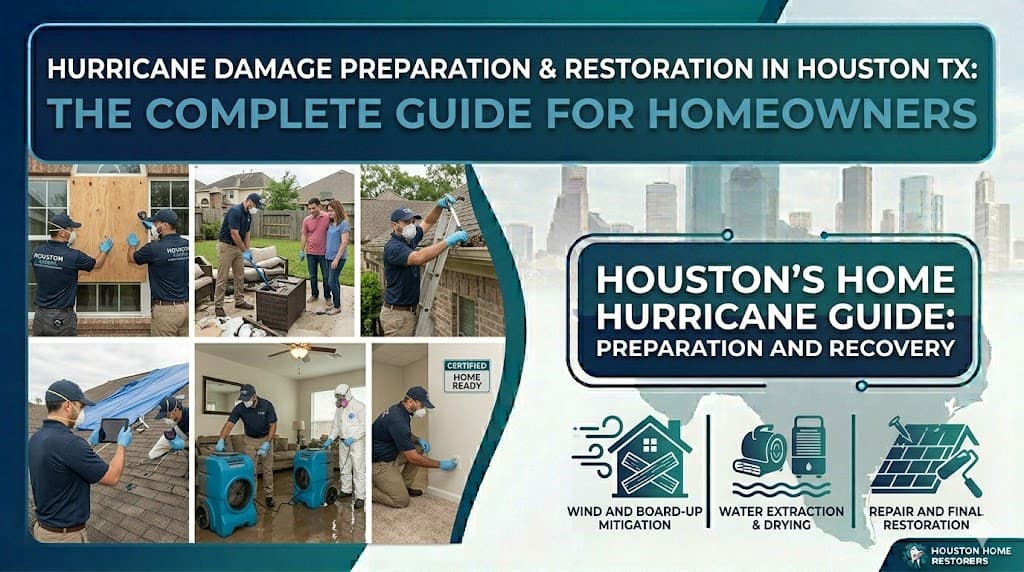
Houston sits squarely in one of the most hurricane-prone corridors in the United States. From Hurricane Ike in 2008 to Hurricane Harvey in 2017, every major storm that has struck the Texas Gulf Coast has left a trail of wind damage, catastrophic flooding, and months-long recovery timelines for homeowners and businesses across Harris County, Fort Bend County, Galveston County, Montgomery County, and Chambers County. The question for Houston-area property owners is not whether a hurricane will affect your home — it is how prepared you are when it does.
This guide covers everything Houston homeowners need to know about hurricane preparation, the types of damage hurricanes cause, the storm damage restoration process, and how to navigate the often-complicated insurance claims process that follows. Whether you are reading this before hurricane season begins or in the aftermath of a storm, the information here will help you protect your property and recover faster.
Houston's Hurricane History: Why Preparation Is Non-Negotiable
The Houston metropolitan area has been impacted by major tropical systems repeatedly over the past two decades. Hurricane Ike made landfall in Galveston in September 2008 as a Category 2 storm, producing a storm surge that devastated coastal communities and caused wind damage across the entire metro area. Total damages exceeded $29 billion, and thousands of Houston-area homes required extensive restoration.
Hurricane Harvey in August 2017 was a different kind of catastrophe. Harvey stalled over the Houston region for four days, dumping over 60 inches of rain in some areas and flooding more than 200,000 homes. Harvey exposed a critical gap in hurricane preparedness across Greater Houston: tens of thousands of homeowners who had never flooded before discovered they had no flood insurance, and the distinction between wind damage (covered by homeowner policies) and flood damage (requiring separate NFIP coverage) became painfully real.
Tropical Storm Imelda in 2019 and Tropical Storm Beta in 2020 reinforced the pattern. Houston does not need a Category 4 or 5 hurricane to sustain devastating damage. Slow-moving tropical systems that produce sustained rainfall over several days can be equally destructive to homes and businesses across the region.
The lesson from every one of these events is the same: homeowners who prepare before hurricane season and have a restoration plan in place recover faster, spend less, and avoid the secondary damage — particularly mold — that compounds the original storm damage.
Hurricane Season Timeline: When Houston Is Most at Risk
The Atlantic hurricane season officially runs from June 1 through November 30, but the highest risk period for Houston falls between August and October. This is when sea surface temperatures in the Gulf of Mexico peak, providing the energy that fuels tropical cyclone development and intensification.
Key dates and patterns Houston homeowners should understand:
Early-season storms less intense. Best prep window.
Harvey: Aug 25. Ike: Sept 13. Most major TX hurricanes.
Unpredictable tracks. Rapid Gulf intensification possible.
Risk fades but late-season systems still possible.
Critical Takeaway
All hurricane preparation should be completed by June 1. Waiting until a storm enters the Gulf means competing with every other homeowner for supplies, contractors, and materials.
The practical takeaway is that all hurricane preparation should be completed by June 1. Waiting until a storm enters the Gulf means competing with every other homeowner for supplies, contractors, and materials.
Pre-Hurricane Preparation Checklist for Homeowners
The actions you take before a hurricane determines how much damage your home sustains and how quickly you can recover afterward. This checklist covers the most critical preparation steps for Houston-area homeowners.
Structural and Exterior Preparation
- Inspect your roof: Have a professional roof inspection done before hurricane season. Loose, damaged, or missing shingles become projectiles in high winds and create entry points for rain. Ensure flashing around vents, chimneys, and skylights is sealed.
- Secure windows and doors: Install hurricane shutters or have pre-cut plywood panels ready for every window. Reinforce garage doors, which are one of the most common points of structural failure during hurricanes. Consider impact-resistant windows if you are in a high-risk zone.
- Clear your yard: Remove or secure any outdoor items that could become wind-borne debris — patio furniture, potted plants, grills, trampolines, and loose landscaping materials. Trim trees and remove dead branches that could fall on your home or your neighbor's property.
- Check your sump pump and drainage: Ensure your sump pump is operational and has a battery backup. Clear all gutters, downspouts, and yard drains of debris so water can flow away from your foundation.
- Seal gaps and openings: Caulk around windows, doors, and any exterior penetrations. Water-driven laterally by hurricane-force winds can enter through gaps that are normally weathertight.
Interior and Documentation Preparation
- Document your property: Walk through your entire home and record a video inventory of every room, including the contents of closets, cabinets, and the garage. Photograph serial numbers on electronics and appliances. Store this documentation in the cloud or on a device you take with you if you evacuate.
- Elevate valuables: Move important documents, electronics, and irreplaceable items to upper floors or high shelves. If your home is at risk of flooding, assume floodwater will reach at least two feet above ground level.
- Know your shutoff locations: Mark and practice turning off your main water valve, gas supply, and electrical breaker. You may need to shut these off quickly if damage occurs during the storm.
- Review your insurance policies: Confirm what your homeowner policy covers, verify your flood insurance is active (there is a 30-day waiting period for new NFIP policies), and understand your deductibles. Many Texas homeowner policies have separate hurricane or wind/hail deductibles that are higher than the standard deductible.
- Identify a restoration company in advance: Do not wait until after a hurricane to search for a hurricane damage restoration company. Research and identify a reputable, IICRC-certified restoration company before the season starts. Save their emergency contact number in your phone.
Pre-Hurricane Preparation for Commercial Properties
Commercial properties face additional challenges during hurricane season. Business owners and property managers across Houston need to plan for both physical protection and business continuity.
- Develop a hurricane action plan: Assign specific roles and responsibilities for securing the building, backing up data, protecting inventory, and communicating with employees and tenants. Rehearse the plan annually.
- Protect critical equipment and inventory: Elevate servers, electrical panels, and high-value inventory above anticipated flood levels. Move critical documents offsite or to secure cloud storage. Wrap sensitive equipment in waterproof covers.
- Reinforce the building envelope: Commercial buildings with large glass storefronts, loading dock doors, and flat roofs are particularly vulnerable. Install hurricane-rated window protection, reinforce dock doors, and inspect flat roof membranes and drains for any deterioration.
- Review commercial insurance: Verify that your commercial property policy includes wind and named-storm coverage, and confirm whether you have separate commercial flood insurance. Business interruption coverage is essential for companies that cannot afford extended downtime.
- Establish a hurricane commercial damage restoration partnership: Large commercial properties require restoration companies with the equipment, manpower, and experience to handle large-scale water extraction, structural drying, and reconstruction. Establish this relationship before hurricane season so response times are immediate when a storm hits.
Types of Hurricane Damage in Houston
Hurricanes inflict damage through multiple mechanisms, and understanding the types of damage is critical both for preparation and for navigating insurance claims afterward. Each type of damage may be covered differently under your insurance policies.
Wind Damage
Hurricane-force winds (74+ mph) and even tropical storm-force winds (39-73 mph) cause direct structural damage. The most common wind damage in Houston includes torn or missing roof shingles, broken windows and sliding glass doors, siding ripped from exterior walls, structural damage to carports, porches, and fences, and downed trees impacting roofs and vehicles. Wind damage is typically covered under standard homeowner insurance policies, though many Texas policies carry a separate named-storm or wind/hail deductible calculated as a percentage of the dwelling coverage rather than a flat dollar amount.
Storm Surge and Flooding
For Houston-area properties near the coast, Galveston Bay, or along bayous and waterways, storm surge and hurricane-induced flooding represent the greatest threat to life and property. Harvey demonstrated that even homes miles from any waterway can flood when rainfall exceeds the capacity of the drainage system. Hurricane flood restoration requires rapid water extraction, thorough structural drying, contamination treatment (floodwater carries sewage, chemicals, and debris), and often extensive material removal and replacement.
Flood damage from rising water is not covered by homeowner insurance. It requires a separate flood insurance policy through the National Flood Insurance Program (NFIP) or a private flood insurer. This is the single most important insurance distinction Houston homeowners need to understand before hurricane season.
Debris Impact Damage
Airborne debris is responsible for a significant portion of hurricane damage. Falling trees, broken branches, loose building materials from neighboring properties, and unsecured outdoor items can penetrate roofs, break windows, damage siding, and destroy vehicles. Debris impact that creates an opening in the building envelope leads to secondary water damage as rain enters the structure. Immediate emergency board-up is critical to prevent this secondary damage.
Mold Growth After Hurricanes
Mold is the most common form of secondary hurricane damage, and in Houston's climate, it is virtually guaranteed after any flooding or prolonged water intrusion. Mold can begin colonizing wet materials within 24 to 48 hours, and Houston's post-hurricane heat and humidity create optimal growth conditions. After Hurricane Harvey, mold remediation became the longest and most expensive phase of recovery for thousands of Houston homeowners. The key to controlling mold is rapid water extraction and professional structural drying within the first 24 to 72 hours after the water recedes.
What to Do Immediately After a Hurricane Hits
The first 24 to 72 hours after a hurricane are critical. The actions you take during this window directly determine how much secondary damage your property sustains and how smoothly the restoration and insurance claims process will go.
- Ensure safety first. Do not return to your property until authorities have cleared the area. Watch for downed power lines, gas leaks, standing water with potential electrical hazards, and structural damage that could cause collapse. If you smell gas, leave immediately and call 911.
- Document everything before touching anything. Before you start any cleanup, photograph and video record all damage from multiple angles. Document water lines on walls, damage to the roof, broken windows, debris locations, and the condition of every room. This documentation is essential for both your homeowner and flood insurance claims.
- Contact your insurance companies. File claims with both your homeowner insurance carrier and your flood insurance carrier as soon as possible. The sooner you file, the sooner an adjuster is assigned. Ask for your claim number and the adjuster's contact information.
- Call a hurricane damage restoration company. Contact a professional restoration company to begin emergency mitigation: water extraction, board-up of openings, roof tarping, and structural drying. Do not wait for the insurance adjuster before beginning mitigation — your policy requires you to take reasonable steps to prevent further damage, and emergency mitigation costs are covered.
- Prevent mold. If your home has standing water, begin extraction immediately. Open windows and doors if weather permits. Run fans and dehumidifiers if you have power. Remove wet carpet, padding, and any soaked materials that cannot be dried within 48 hours. Every hour of delay in this window increases the likelihood and severity of mold growth.
- Keep all receipts. Any expenses related to emergency repairs, temporary housing, mitigation, and cleanup may be reimbursable under your insurance policies. Save every receipt, photograph every repair, and keep a written log of all activities and communications.
The Hurricane Damage Restoration Process
Professional hurricane damage restoration follows a systematic process designed to stabilize the structure, remove damage, and restore the property to its pre-storm condition. Here is what to expect when you work with a qualified hurricane damage restoration company.
Phase 1: Emergency Mitigation (First 24-48 Hours)
The immediate priority is stopping further damage. This includes emergency water extraction using truck-mounted pumps and commercial extractors, temporary roof tarping to prevent additional rain intrusion, board-up of broken windows and compromised openings, emergency power for drying equipment if grid power is unavailable, and initial moisture mapping to assess the full extent of water intrusion. LPR Mitigation Services provides 24/7 emergency response throughout the Greater Houston area, including during and immediately after tropical weather events.
Phase 2: Assessment and Documentation
Once the structure is stabilized, a thorough damage assessment is completed. This includes detailed moisture readings throughout the structure using professional-grade meters, thermal imaging to identify hidden water intrusion in walls, ceilings, and subfloors, structural integrity evaluation, documentation of all damage with photographs, moisture readings, and written reports for insurance purposes, and a detailed scope of work and restoration plan. This documentation is critical for your insurance claims. A professional restoration company creates the detailed loss documentation that supports your claim and helps ensure you receive the full coverage you are entitled to.
Phase 3: Water Removal and Structural Drying
This is the most technically critical phase of hurricane flood restoration. Industrial-grade dehumidifiers and air movers are deployed throughout the structure. Daily moisture readings track the drying progress of walls, subfloors, and structural components. Contaminated materials that cannot be salvaged — wet drywall, insulation, carpet padding, and particleboard — are removed and disposed of properly. The goal is to bring all structural materials below 15% moisture content before any reconstruction begins. Rushing this phase is the single most common mistake in hurricane restoration, and it leads directly to mold problems weeks or months later.
Phase 4: Cleaning, Sanitizing, and Mold Prevention
After the structure is dried, all affected surfaces are cleaned and treated with antimicrobial solutions to prevent mold colonization. Floodwater is classified as Category 3 (grossly contaminated) water, meaning it contains sewage, chemicals, soil, and biological contaminants. All surfaces that contacted floodwater require professional cleaning and sanitization. HVAC systems are inspected, cleaned, and treated to prevent mold spore distribution throughout the home.
Phase 5: Reconstruction and Restoration
The final phase involves rebuilding and restoring the property to its pre-storm condition. This includes replacing drywall, insulation, flooring, trim, and any structural components that were damaged or removed during the drying phase. Electrical and plumbing systems are inspected and repaired. The property is painted, finished, and returned to a livable condition. A full-service hurricane damage restoration company handles this entire process from emergency response through final reconstruction, providing a single point of contact and accountability throughout the recovery.
Hurricane Damage? Call LPR Mitigation Services Now.
We provide 24/7 emergency hurricane damage restoration across Greater Houston. From emergency board-up and water extraction to full reconstruction, our IICRC-certified team handles every phase of recovery. We work directly with your insurance company to document damage and support your claim.
Hurricane Insurance in Houston: Homeowner vs. Flood Insurance
Understanding the difference between homeowner insurance and flood insurance is arguably the most important financial decision a Houston homeowner can make before hurricane season. These are two completely separate policies, and the distinction between what each covers is the source of more post-hurricane disputes and financial hardship than any other issue.
| Coverage | Homeowner Insurance (HO-3) | Flood Insurance (NFIP) |
|---|---|---|
| Wind Damage | Covered ✓ | Not Covered |
| Rain Through Wind Opening | Covered ✓ | Not Covered |
| Rising Floodwater | Not Covered | Covered ✓ |
| Storm Surge | Not Covered | Covered ✓ |
| Max Coverage | Varies by policy | $250K structure / $100K contents |
| Deductible | 1–5% of dwelling (hurricane) | $1,000 – $10,000 flat |
Critical Insurance Gap
During hurricanes, most Houston homes sustain damage from both wind and flooding simultaneously. You need both policies. A $400,000 home with a 2% hurricane deductible = $8,000 out of pocket before homeowner coverage kicks in.
The Critical Gap: What Neither Policy Covers Alone
During a hurricane, most Houston homes sustain damage from both wind and flooding simultaneously. The roof is damaged by wind, allowing rain to enter from above, while floodwater rises from below. The homeowner insurance carrier covers the wind and rain-through-opening damage. The flood insurance carrier covers the rising water damage. But the homeowner is caught in the middle, trying to prove which damage was caused by which peril, while both carriers look for reasons to attribute damage to the other policy.
This is where thorough documentation and a professional restoration company that understands the insurance process becomes invaluable. LPR Mitigation Services provides detailed damage documentation that clearly identifies and separates wind damage from flood damage, supporting your claims with both carriers.
NFIP Claims: Timelines and Documentation Requirements
Filing a National Flood Insurance Program claim involves specific requirements and deadlines that Houston homeowners must follow carefully to avoid having their claim reduced or denied.
- Report the loss promptly: Contact your flood insurance agent or the NFIP directly as soon as possible after the flood. While there is no strict reporting deadline, delayed reporting can complicate your claim.
- Proof of Loss deadline: You must file a signed, sworn Proof of Loss with your flood insurance carrier within 60 days of the flood. This is a firm deadline, and failure to submit the Proof of Loss on time can result in claim denial. After major disasters, FEMA may grant extensions, but you should not rely on this.
- Separate your damaged property: Do not throw away flood-damaged materials until they have been documented by photograph and inspected by the flood insurance adjuster. Place damaged items outside, separated by category (electronics, furniture, building materials), for the adjuster's inspection.
- Keep all receipts: Document every expense related to the flood damage, including emergency water extraction, temporary repairs, cleanup supplies, and temporary housing costs.
- Cooperate with the adjuster: The NFIP adjuster will inspect your property and prepare an estimate. Review this estimate carefully. If you believe the estimate undervalues your damage, you can submit supplemental claims with additional documentation.
Dual Claims: When Both Homeowner and Flood Insurance Apply
After a hurricane, filing dual claims with both your homeowner and flood insurance carriers is common and often necessary. The process requires careful coordination to ensure all damage is covered and neither carrier is able to deny coverage by attributing damage to the other policy.
The key to successful dual claims is damage differentiation. Wind damage is characterized by damage to the roof, upper portions of the structure, and items damaged by rain entering through wind-created openings. Flood damage is characterized by water lines on walls, damage concentrated at or near ground level, and contamination consistent with rising floodwater. Damage from both perils can overlap in the same areas, which is where disputes arise.
A professional insurance claims assistance process that includes detailed moisture mapping, photographic documentation with timestamps, and a clear written scope separating wind damage from flood damage gives you the strongest position with both carriers. LPR Mitigation Services documents every project with this level of detail specifically because we understand how critical it is for Houston homeowners dealing with dual hurricane claims.
How to Choose a Hurricane Damage Restoration Company
After every major hurricane, Houston sees an influx of out-of-state contractors and fly-by-night operations looking to capitalize on the demand for restoration services. Choosing the wrong company can result in substandard work, prolonged recovery timelines, and denied insurance claims. Here is what to look for in a legitimate hurricane restoration company.
- IICRC certification: The Institute of Inspection, Cleaning, and Restoration Certification (IICRC) sets the industry standard for water damage restoration. Verify that the company holds current IICRC certifications in water damage restoration (WRT) and applied structural drying (ASD).
- Texas licensing: Verify the company is properly licensed to operate in Texas. Mold remediation requires a specific TDLR license in Texas.
- Local presence and track record: Choose a company that is established in the Houston area, not one that arrives after a storm and will be gone before the work is complete. A local company has accountability to the community and will be available for warranty issues.
- Insurance claims expertise: Your restoration company should understand the insurance documentation process and be able to provide the detailed loss reports, moisture logs, and photographic evidence that support your claim. Ask whether they work directly with insurance adjusters.
- 24/7 emergency response: Hurricane damage does not wait for business hours. Your restoration company must offer genuine 24/7 response capability with crews and equipment ready to deploy immediately.
- Full-service capability: The best outcome comes from a single company that handles emergency mitigation, water extraction, structural drying, mold prevention, and full reconstruction. This eliminates coordination problems between multiple contractors and provides a single point of accountability.
- No large upfront payments: Legitimate restoration companies work with your insurance company on payment. Be wary of any contractor who demands full payment before work begins or pressures you to sign a contract before your adjuster has inspected the damage.
Frequently Asked Questions About Hurricane Damage Restoration
How long does hurricane damage restoration take in Houston?
The timeline depends on the severity of the damage. Minor wind damage repairs such as roof tarping and broken window replacement can be completed in a few days. Moderate water damage requiring structural drying typically takes one to two weeks. Major hurricane damage involving flooding, structural repairs, mold remediation, and full interior reconstruction can take several weeks to several months. Working with an experienced hurricane damage restoration company like LPR Mitigation Services helps ensure the process moves as quickly as possible while meeting insurance documentation requirements.
Does homeowner insurance cover hurricane damage in Texas?
Standard Texas homeowner insurance covers wind damage, rain damage that enters through a wind-created opening, and debris impact damage. However, flood damage from storm surge or rising water is excluded from homeowner policies and requires a separate National Flood Insurance Program (NFIP) policy or private flood insurance. Many Houston homeowners discover this gap only after a hurricane. If your home sustains both wind and flood damage, you may need to file dual claims with both carriers.
Should I file a flood insurance claim or homeowner claim after a hurricane?
If your home sustained damage from both wind and flooding during a hurricane, you should file claims with both your homeowner insurance carrier and your flood insurance carrier. Wind-driven rain entering through a damaged roof is typically covered under your homeowner policy, while rising floodwater damage is covered under your NFIP or private flood policy. Documenting the damage source carefully is critical because each carrier will only cover damage caused by their covered peril. A professional restoration company can help document and differentiate damage types for both claims.
How soon after a hurricane should I start the restoration process?
You should begin the restoration process as soon as it is safe to return to your property. Mold can begin growing within 24 to 48 hours of water exposure, and Houston's heat and humidity accelerate this timeline significantly. Emergency services like water extraction, board-up, and roof tarping should happen within the first 24 hours if possible. Contact a hurricane damage restoration company immediately, even before your insurance adjuster visits, to begin emergency mitigation and prevent secondary damage.
What should I look for when choosing a hurricane restoration company in Houston?
Look for a company that holds IICRC certification for water damage restoration and is licensed in the State of Texas. They should have documented experience with hurricane damage specifically, not just general restoration. Verify they offer 24/7 emergency response, can handle both residential and commercial properties, work directly with insurance companies on claims documentation, and have sufficient crew and equipment to handle large-scale hurricane damage. Avoid any contractor who demands full payment upfront or pressures you to sign before your insurance adjuster inspects the damage.
Hurricane & Storm Damage Resources for Houston
- Storm & Hurricane Damage Restoration in Houston TX →
- Hurricane Flood Damage Restoration & Cleanup Houston →
- Roof Leak & Wind Damage Restoration in Houston →
- 24/7 Emergency Board-Up & Roof Tarping Services →
- Hurricane Commercial Property Damage Restoration →
- Hurricane Insurance Claims Help (NFIP & Homeowner Dual Claims) →
- Does Homeowner Insurance Cover Hurricane Water Damage in Texas? →
- Houston Storm Damage Restoration — The Complete Guide →