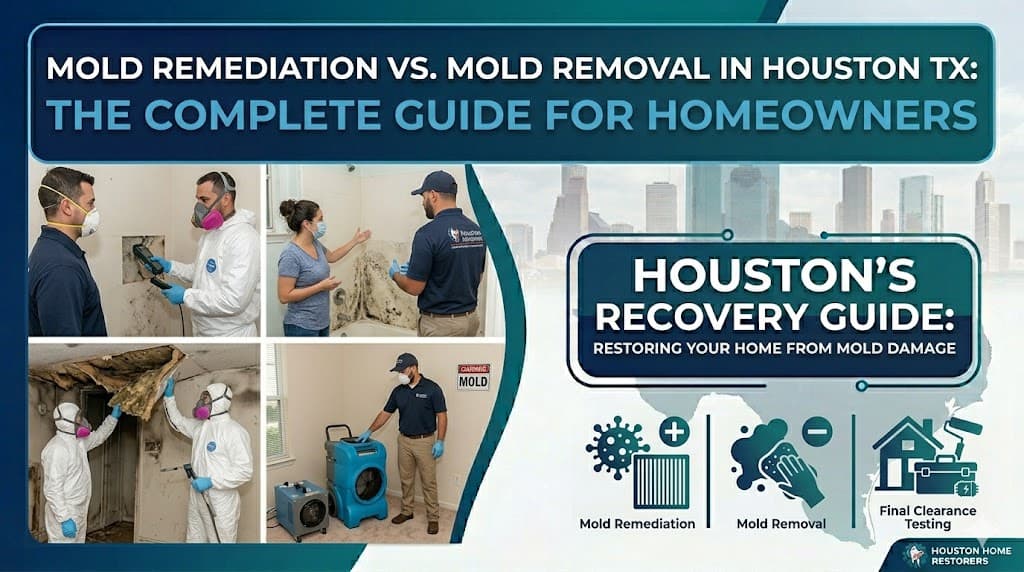
If you've found mold in your Houston home, you've probably searched for both “mold removal” and “mold remediation” and wondered whether they mean the same thing. They don't — and understanding the difference matters for your health, your home, and your wallet. This guide breaks down what each term actually means, what the professional process looks like, and what Houston homeowners should expect when dealing with mold.
Mold Remediation vs Mold Removal: What's the Actual Difference?
The terms “mold removal” and “mold remediation” are often used interchangeably by homeowners, but in the restoration industry, they describe two very different things.
| Feature | Mold Removal | Mold Remediation ✓ |
|---|---|---|
| Definition | Eliminate all mold | Return mold to safe levels |
| Realistic? | Impossible | Yes — Industry Standard |
| Addresses Root Cause? | Often no | Yes — moisture source resolved |
| Approach | Surface cleaning only | Containment, removal, treatment, drying, verification |
| Follows IICRC Standards? | Rarely | Yes — S520 certified process |
| Long-Term Results | Mold likely returns | Lasting solution with prevention |
Red Flag
Any company that guarantees “complete mold removal” or promises to make your home “mold-free” is misrepresenting the science. Mold spores exist naturally in every environment — the goal is controlling levels, not elimination.
This distinction is not just semantics. It shapes how a qualified company approaches the work, what outcomes are realistic, and what you should expect when the project is finished.
Why “Mold Removal” Is Misleading
Mold spores are a natural part of every indoor and outdoor environment. They exist in the air you breathe right now, regardless of how clean your home is. According to the EPA and every major restoration industry standard, it is impossible to remove all mold and mold spores from an indoor environment.
Any company that guarantees “complete mold removal” or promises to make your home “mold-free” is either misrepresenting the science or using marketing language that doesn't reflect what actually happens during the project. This is a red flag worth paying attention to when choosing a contractor.
The goal of professional mold work is not to eliminate every spore. The goal is to remove active mold colonies and contaminated materials, reduce airborne spore counts to normal background levels, and eliminate the moisture conditions that allowed the mold to grow. That process is mold remediation — and it is the industry standard for good reason.
What Professional Mold Remediation Actually Involves
Professional mold remediation is a systematic, multi-step process governed by IICRC S520 standards and, in Texas, regulated by the Texas Department of Licensing and Regulation (TDLR). Here is what a legitimate remediation project looks like from start to finish.
The process begins with a thorough inspection and moisture assessment. Technicians use moisture meters, thermal imaging cameras, and hygrometers to identify every area where moisture and mold are present — including behind walls, under flooring, and inside HVAC ductwork. This step determines the full scope of the problem before any removal work begins.
Next, the affected area is isolated using physical containment barriers (polyethylene sheeting) and negative air pressure to prevent spores from spreading to uncontaminated areas of the home. HEPA air filtration devices run continuously throughout the project to capture airborne spores.
Contaminated materials that cannot be cleaned — typically drywall, insulation, carpet, and carpet padding — are carefully removed and bagged for disposal. Structural materials like wood framing and concrete that can be salvaged are treated with HEPA vacuuming and antimicrobial solutions.
After removal, the entire contained area is HEPA vacuumed, treated with antimicrobial agents, and thoroughly dried using commercial dehumidification and drying equipment. The drying phase is critical — if moisture remains, mold will return regardless of how thorough the cleaning was.
Finally, post-remediation verification (often called clearance testing) confirms that the work was successful. In Texas, a third-party licensed mold assessment consultant typically performs this testing independently from the remediation company.
When You Need Professional Help vs DIY
Not every mold situation requires a professional remediation crew. The EPA generally recommends professional remediation when the affected area exceeds 10 square feet (roughly a 3-by-3-foot patch). Below that threshold, homeowners can sometimes handle the cleanup themselves — with the right precautions.
- ✓ Mold on non-porous surface (tile, glass, metal)
- ✓ Affected area under 10 sq ft
- ✓ No mold behind walls or under flooring
- ✓ Moisture source already fixed
- ✓ Use N-95 respirator, gloves, eye protection
- ✗ Mold covers more than 10 sq ft
- ✗ Growing on drywall, wood, insulation, or carpet
- ✗ Mold inside wall cavities or HVAC
- ✗ Resulted from flooding or water damage
- ✗ Health symptoms or insurance claim involved
Houston's Mold Problem: Why the Climate Makes It Worse
Houston sits in one of the most mold-prone climates in the United States. The combination of high humidity (regularly exceeding 80% relative humidity), warm temperatures year-round, heavy rainfall, and frequent tropical weather events creates conditions where mold thrives.
Unlike homes in drier climates where minor leaks may dry out on their own, moisture in Houston homes tends to persist. Wall cavities, attic spaces, and crawl areas stay damp for extended periods because the ambient humidity prevents natural evaporation. This is why mold growth in Houston is often more extensive and more deeply embedded than homeowners expect.
Communities across the Greater Houston area deal with these conditions. Whether you are in League City near Galveston Bay, in the established neighborhoods of the Meyerland area, or in the growing communities of Montgomery County, the climate-driven mold risk is consistent. Homes in low-lying areas or near waterways face additional risk from flooding and poor drainage.
Air conditioning compounds the problem. The temperature differential between cooled indoor air and hot, humid outdoor air creates condensation inside wall cavities, especially on exterior-facing walls. Homes with inadequate insulation or vapor barriers are particularly susceptible.
Common Places Mold Hides in Houston Homes
Mold does not always announce itself with visible growth or obvious odors. In Houston homes, some of the most common hiding places include:
- Behind drywall near plumbing fixtures — Slow leaks under sinks, behind toilets, and around washing machine connections create persistent moisture inside wall cavities.
- Inside HVAC ductwork and air handlers — Condensation on cooling coils and inside supply ducts provides moisture, while dust provides food for mold. A contaminated HVAC system distributes spores throughout the entire home.
- Under carpet and padding — Carpet that was wet from a leak or flood and not properly dried is one of the most common mold sources in Houston. The padding traps moisture and is nearly impossible to dry completely without removal.
- In attic spaces — Bathroom exhaust fans vented into the attic (instead of outside), roof leaks, and poor attic ventilation create ideal mold conditions. Many Houston homeowners never inspect their attics and miss significant growth.
- Behind baseboards and trim — After flooding or slab leaks, moisture wicks up through drywall and collects behind baseboards where it is invisible from the living space.
- Inside closets on exterior walls — Poor air circulation combined with condensation on exterior-facing walls makes closets a frequent mold location, especially in older Houston homes without adequate insulation.
- Under vinyl flooring and in subfloor materials — Vinyl traps moisture between the flooring surface and the subfloor, creating a hidden environment where mold can grow for months without any visible indication.
If you suspect mold but cannot see it, a professional mold inspection using moisture meters and thermal imaging can locate hidden growth without unnecessary demolition.
The Mold Remediation Process: Step by Step
Understanding the process helps you know what to expect and evaluate whether a contractor is following industry standards. Here is the standard professional mold remediation process:
Initial Inspection & Assessment
Certified technician maps moisture readings, identifies the moisture source, and determines contamination scope.
Moisture Source Repair
Water or moisture source must be stopped first — plumbing repairs, roof fixes, or drainage corrections.
Containment
Affected area sealed with polyethylene barriers and negative air pressure to prevent spore migration.
Air Filtration
HEPA air scrubbers filter particles down to 0.3 microns, capturing the vast majority of mold spores.
Removal of Contaminated Materials
Porous materials (drywall, insulation, carpet) carefully removed, double-bagged, and disposed of.
Cleaning & Treatment
Structural materials HEPA vacuumed and treated with antimicrobial solutions. Contents may also need cleaning.
Drying
Commercial dehumidifiers and air movers until all materials reach acceptable moisture levels. Takes longer in Houston's climate.
Post-Remediation Verification
Third-party clearance testing confirms spore counts are normal. Required by Texas regulation.
Mold Testing: When You Need It and When You Don't
Mold testing is not always necessary, and a good contractor will tell you that upfront. Here is a practical guide:
You generally do not need testing when: you can see visible mold growth and already know it needs to be addressed. In that case, the priority is remediation, not confirming what your eyes already tell you. Spending money on testing when the mold is obvious delays the actual work.
You do need testing when: you smell mold but cannot see it (testing helps confirm the presence and identify the type); you need documentation for an insurance claim (many Texas insurers require pre- and post-remediation testing); household members have health symptoms and you need to establish whether mold is the cause; you are purchasing a home and want to verify indoor air quality; or after remediation is complete, to verify the work was successful (post-remediation clearance testing).
In Texas, mold assessment (testing) and mold remediation must be performed by separately licensed companies. A single company cannot legally perform both the assessment and the remediation on the same project. This separation exists to prevent conflicts of interest.
Cost of Mold Remediation in Houston
Mold remediation costs vary significantly depending on the scope of the project. Here are general ranges for the Houston area:
Single bathroom, under-sink area
One room, partial wall removal
Multiple rooms, HVAC involvement
Whole-home after flooding
These ranges include containment, removal, treatment, and drying. They do not include the cost of rebuilding (new drywall, paint, flooring) which is a separate phase that typically follows remediation.
Factors that affect cost include the total square footage of contaminated area, the type of materials involved (drywall and insulation are cheaper to replace than hardwood framing), accessibility of the affected area, whether the HVAC system is contaminated, and whether the moisture source still needs to be repaired.
Be cautious of bids that seem unusually low. Companies that skip containment, air filtration, or post-remediation testing can offer lower prices, but the mold is likely to return — costing you more in the long run.
Insurance and Mold: What Texas Homeowners Policies Cover
Mold coverage in Texas homeowners insurance is limited but not nonexistent. Most standard policies include a mold endorsement with a coverage cap, typically $25,000. However, whether your claim is approved depends largely on the cause of the mold.
Generally covered: Mold resulting from a sudden, accidental covered peril — such as a burst pipe, an appliance malfunction (washing machine hose failure, water heater rupture), or storm damage to the roof that allowed rainwater in.
Generally not covered: Mold from gradual leaks that went unrepaired, poor home maintenance, construction defects, flooding (unless you have separate flood insurance through the NFIP or a private policy), or long-term humidity problems.
The key to a successful mold claim in Texas is documentation. Report the water damage to your insurer as soon as it happens. Document the damage with photos and video before cleanup begins. Keep records of all professional assessments and remediation work. Hire TDLR-licensed contractors so the work meets the insurer's requirements.
If you are navigating a mold-related insurance claim, our team can help with documentation, direct insurer communication, and ensuring the work meets all requirements for claim approval. Learn more about our insurance claims assistance.
Prevention Tips for Houston Homeowners
Preventing mold in Houston requires active moisture management. Here are practical steps that make a real difference:
- Keep indoor humidity between 30% and 50%. Use a hygrometer to monitor humidity levels. If your HVAC system cannot maintain this range, a whole-home dehumidifier is a worthwhile investment in the Houston climate.
- Fix leaks immediately. Even small drips under sinks or around toilets create enough moisture for mold to establish within 48 hours. Do not wait to address plumbing issues.
- Ensure proper ventilation. Every bathroom and kitchen should have an exhaust fan that vents directly to the exterior — not into the attic. Run bathroom fans during and for at least 30 minutes after showers.
- Maintain your HVAC system. Change air filters regularly, keep drain lines clear, and have your system serviced annually. A malfunctioning HVAC system is one of the most common sources of indoor mold in Houston.
- Direct water away from your foundation. Ensure gutters are clean, downspouts extend at least 6 feet from the foundation, and yard grading slopes away from the house.
- Act fast after any water event. If your home experiences water damage from a leak, storm, or appliance failure, begin drying within 24 hours. The faster wet materials are dried, the lower the chance of mold growth.
- Inspect your attic and crawl spaces annually. These areas are out of sight and out of mind for most homeowners, but they are among the most common locations for hidden mold growth in Houston.
- Do not carpet bathrooms or below-grade areas. Carpet in high-moisture areas is a mold problem waiting to happen, especially in the Houston climate.
Think You Have a Mold Problem?
If you've noticed warning signs of mold in your Houston home, don't wait for it to spread. LPR Mitigation Services provides IICRC-certified, TDLR-licensed mold remediation services across Greater Houston — including League City, Montgomery County, Meyerland, and all surrounding communities.
We offer free mold inspections in Greater Houston so you know exactly what you are dealing with before any work begins. No pressure, no scare tactics — just a professional assessment and clear options.
Call 346-222-4481Frequently Asked Questions
Is mold remediation the same as mold removal?
No. Mold removal implies eliminating all mold, which is not scientifically possible since mold spores exist naturally in every environment. Mold remediation is the professional process of returning mold levels to normal, safe concentrations by removing contaminated materials, treating affected areas, and resolving the moisture source. Any company that promises total mold removal is not being accurate about what is achievable.
How much does mold remediation cost in Houston?
Costs typically range from $1,500 for small projects (under-sink area, single bathroom) to $15,000 or more for large projects involving multiple rooms or HVAC contamination. The primary cost drivers are the size of the affected area, the type of materials that need to be removed, and whether the HVAC system is involved. Rebuilding costs (new drywall, paint, flooring) are separate from remediation costs.
Does homeowners insurance cover mold remediation in Texas?
Most Texas homeowners policies include limited mold coverage, often capped at $25,000. Coverage typically applies when mold results from a sudden, covered event like a burst pipe or appliance failure. Mold from gradual leaks, maintenance neglect, or flooding (without separate flood insurance) is usually excluded. Prompt reporting and documentation are essential for claim approval.
Can I handle mold cleanup myself?
Small mold patches on non-porous surfaces (less than 10 square feet on tile, glass, or metal) can sometimes be managed with proper protective equipment and cleaning solutions. However, mold on drywall, wood, insulation, carpet, or inside HVAC systems requires professional remediation. Improper cleanup can spread spores to other areas and create a larger problem. When in doubt, start with a professional assessment.
How long does professional mold remediation take?
Most residential projects take 3 to 7 days, including containment setup, material removal, treatment, drying, and post-remediation verification. Larger projects or those involving significant structural damage may take longer. The timeline also depends on whether the moisture source has been fully resolved — remediation cannot begin until the water problem is fixed, or the mold will return.
Related Mold & Moisture Resources
- Professional Mold Remediation Services in Houston (TDLR Licensed) →
- Warning Signs of Mold in Your Houston Home →
- Water Damage Restoration in Houston (Prevents Mold Growth) →
- Dehumidification & Structural Drying (Mold Prevention) →
- Mold Damage Insurance Claims Help for Texas Homeowners →
- Does Homeowner Insurance Cover Mold & Water Damage in Texas? →
- Mold Remediation Services in League City, TX →
- Mold Remediation in Montgomery County (Conroe & The Woodlands) →
- Schedule a Free Mold Inspection in Greater Houston →