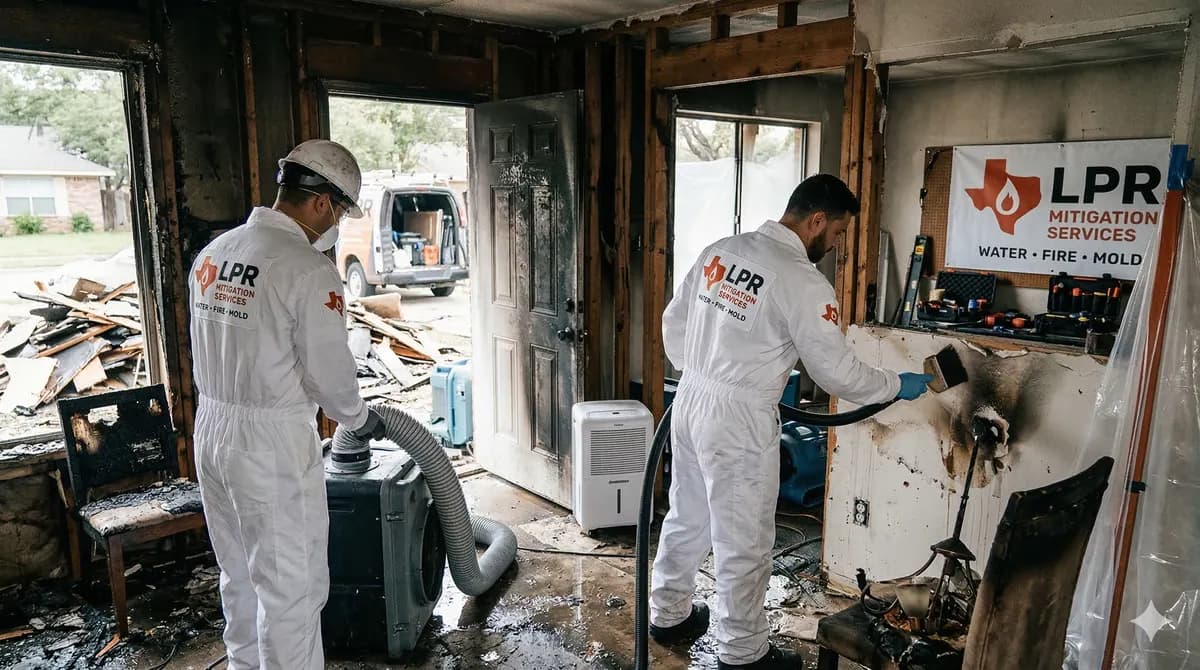
If your Texas home has been damaged by fire, the questions hit fast: How much will this cost? Will my insurance cover it? Where do I even start? The honest answer to the first question is that fire restoration costs span a much wider range than most other property losses — from a few thousand dollars for a small kitchen smoke event to several hundred thousand for a major structural rebuild. This guide breaks down real numbers based on jobs we see across Greater Houston every week.
At LPR Mitigation Services, we're a full-service fire damage restoration company serving Houston, Katy, Sugar Land, Pearland, The Woodlands, Conroe, League City, and surrounding communities. We offer free inspections so you know exactly what you're facing before spending a dollar. Here's what you need to know about fire damage restoration costs in Texas.
Quick Answer
How much does fire damage restoration cost in Texas?
Texas fire damage restoration typically costs $3,000 to $250,000+. Most projects fall into three tiers:
- Smoke-only event (kitchen fire, no structural damage): $3,000 – $15,000
- Mid-size (1–2 rooms, structural damage, suppression water): $15,000 – $50,000
- Whole-home / major structural fire: $50,000 – $250,000+
Final cost depends on smoke types present, square footage affected, contents inventory, HVAC scope, and reconstruction scale. Most fire losses with a covered cause are paid by homeowners insurance across three coverages — dwelling, personal property, and additional living expenses (ALE).
Average Fire Damage Restoration Costs in Texas (2026)
Fire damage restoration costs in Texas range from about $3,000 for a contained kitchen-fire smoke cleanup to $250,000 or more for catastrophic whole-home structural rebuilds. The national average for fire restoration sits around $25,000 to $50,000, but Texas — especially the Gulf Coast — varies based on humidity-driven mold risk, hurricane season suppression water complications, and the cost of skilled reconstruction labor.
Fire Damage Restoration Cost Ranges — Texas 2026
Smoke-Only / Kitchen Fire
Contained event, no structural damage, soot cleanup + odor
$3,000 – $15,000
Mid-Size Fire
1–2 rooms, partial structural damage, suppression water
$15,000 – $50,000
Major Structural Fire
Multiple rooms, significant structural damage, full reconstruction
$50,000 – $150,000
Whole-Home / Catastrophic
Whole-home rebuild, full contents loss, extended ALE
$150,000 – $250,000+
These ranges include emergency board-up, soot and smoke cleanup, water damage cleanup from firefighting, HVAC decontamination, odor elimination, and reconstruction. They do not include cosmetic upgrades, premium-finish substitutions, or contents replacement (which is a separate insurance coverage).
What Determines the Cost of Fire Damage Restoration?
Every fire is different, but five main factors drive the final cost. Understanding these will help you read any estimate you receive — and spot scope gaps from companies that aren't being transparent.
1. Smoke Type Present
Soot is not a single substance — it varies by what burned and how it burned, and each type requires different cleaning chemistry. Applying the wrong method causes permanent surface damage. The four types and their cost implications:
Dry Smoke (paper, wood, fast high-heat fire)
Easiest to clean if approached with proper sequence (dry-then-wet). Cost-additive: low.
Wet Smoke (plastics, foam, slow smoldering)
Sticky, smears, deeply persistent odor. Multiple cleaning passes required. Cost-additive: moderate to high.
Protein Smoke (kitchen fires, grease)
Nearly invisible but coats every surface; requires enzymatic cleaners. Cost-additive: high (frequently underestimated).
Fuel Oil / Furnace Puffback
Petroleum-based, oily; HVAC duct cleaning almost always required. Cost-additive: very high (whole-home distribution typical).
2. Square Footage and Number of Rooms Affected
Soot and smoke distribute through HVAC and air movement to areas far beyond the visible fire. A contained kitchen fire commonly results in protein-smoke contamination across the entire connected living space. Larger fires affect more rooms directly through heat and structural damage. Cost scales roughly with affected square footage but jumps significantly when whole-home contamination triggers HVAC decontamination and contents pack-out.
3. Water Damage from Firefighting
Most fire scenes have significant water damage from suppression — sprinklers, fire department hoses, ruptured pipes from heat. This water saturates drywall, insulation, carpet, and subfloor, requiring Category-appropriate extraction and structural drying as a parallel project to smoke cleanup. In Houston's humidity, suppression water that isn't professionally extracted within 24 hours often produces mold within 48, adding another remediation cost. Water damage restoration from suppression is typically billed alongside fire restoration on the same insurance scope.
4. Reconstruction Scope
Mitigation (board-up, cleanup, drying, decontamination) is roughly 30–50% of the total project cost. Reconstruction (drywall, insulation, electrical, plumbing, flooring, paint, cabinetry, trim) is the remaining 50–70%. Whole-home reconstruction in Texas runs $150 to $400 per square foot depending on finish level. Custom features (hardwood floors, custom cabinetry, premium fixtures) push the per-foot cost higher.
5. Contents Inventory and Restoration
Salvageable contents are inventoried, packed out, professionally cleaned (textiles, electronics, art, documents), and stored during reconstruction. Total-loss items are documented for the contents portion of your insurance claim. Contents work is a separate budget line and typically billed against the personal property coverage of your policy — independent of dwelling coverage.
Does Insurance Cover Fire Damage Restoration in Texas?
Sudden, accidental fire damage is covered under standard Texas homeowners (HO-3) and most commercial property policies. The coverage typically breaks into three sections:
- Dwelling coverage — pays for repair or rebuild of the structure itself, including fire, smoke, soot, and suppression water damage. Subject to your dwelling coverage limit.
- Personal property coverage — pays for replacement or restoration of contents (furniture, clothing, electronics, etc.). Typically 50–70% of dwelling coverage limit.
- Additional Living Expenses (ALE) — pays for temporary housing, increased food costs, and other expenses when your home is uninhabitable during restoration. Often 20–30% of dwelling coverage limit.
Coverage exclusions and pitfalls: arson by the policyholder is not covered; vacant-home fires may have reduced coverage; some policies have ordinance-and-law sublimits that affect bring-to-code reconstruction costs. Your policy deductible (typically $1,000–$2,500) applies to each covered loss. Texas insurance for water and related damages works similarly across coverages.
The most under-claimed coverage on fire losses is ALE. Many homeowners stay with family or pay for hotels out-of-pocket without realizing their policy reimburses these costs with proper documentation. Save every receipt from day one.
Free Fire Damage Inspection — Houston, TX
Get a free, written fire damage scope and cost estimate before committing to any restoration. LPR's in-house claims specialist reviews your policy at no charge and documents the loss across dwelling, personal property, and ALE coverages.
Fire Damage Restoration Cost FAQs
How much does fire damage restoration cost in Texas?
Fire damage restoration in Texas typically costs $3,000 to $250,000+ depending on fire size and scope. Small contained smoke events run $3,000 to $15,000. Mid-size fires affecting one to two rooms with structural damage run $15,000 to $50,000. Whole-home or major structural fires run $50,000 to $250,000+. Most fire losses with a covered cause are paid by homeowners insurance across dwelling, personal property, and ALE coverages.
Does homeowners insurance cover fire damage restoration in Texas?
Yes. Sudden, accidental fire damage is covered under standard Texas homeowners (HO-3) and most commercial property policies. Coverage typically includes the structural rebuild, smoke and soot cleanup, water damage from firefighting, contents replacement, and ALE for temporary housing during restoration. Arson by the policyholder is excluded.
How much does smoke damage cleanup cost without a fire?
Smoke-only damage from a contained kitchen fire, appliance malfunction, or furnace puffback typically costs $1,500 to $8,000. Pricing depends on smoke type, square footage affected, and whether HVAC decontamination is required. Whole-home smoke distribution from a furnace puffback or large fire (without major structural damage) can run $15,000 to $60,000+ when full HVAC ductwork cleaning, contents pack-out, and odor elimination are needed.
How much does it cost to rebuild after a house fire in Texas?
Reconstruction after a fire typically costs $150 to $400 per square foot in Texas — varying by finish level, materials, and structural complexity. A 2,000 sq ft single-family home rebuild after major fire damage can run $300,000 to $800,000 for the structure alone, before contents replacement.
How can I reduce my out-of-pocket fire damage costs?
Document everything immediately with photos and video before cleanup, including all contents. Save receipts for ALE expenses (hotel, meals, transportation). Work with a restoration company that has an in-house insurance claims specialist for dwelling/contents/ALE coverages. Request a free inspection and written scope before committing. Do not accept the first adjuster estimate without scope review — supplemental claims frequently recover thousands more.
Related Fire & Insurance Resources
- Fire Damage Restoration Houston — Company Near You →
- Smoke & Soot Damage Cleanup Houston →
- The Fire Damage Restoration Process Explained →
- Smoke Damage Cleanup: A Houston Guide →
- Water Damage Restoration Cost in Texas (2026 Guide) →
- Insurance Claims Assistance for Damage Restoration →
- Schedule a Free Fire Damage Inspection →