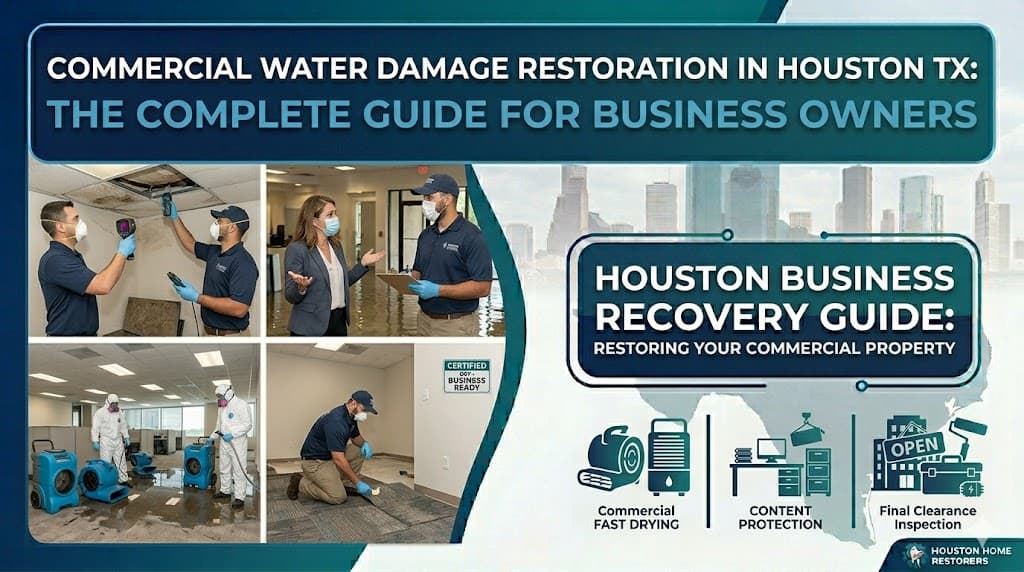
When water damage strikes a commercial property in Houston, the stakes are fundamentally different from a residential situation. You are not just dealing with property damage — you are facing lost revenue, displaced employees, regulatory compliance issues, tenant liability, and the real possibility of permanent business disruption. Commercial water damage restoration demands a level of speed, scale, and expertise that goes far beyond what residential restoration companies typically provide.
At LPR Mitigation Services, we provide full-service commercial restoration services in Houston for office buildings, retail centers, multifamily properties, industrial facilities, and healthcare environments. Our team includes IICRC-certified technicians, an in-house insurance claims specialist, and the commercial-grade equipment required for large-scale mitigation. This guide is built from our direct experience restoring Houston commercial properties after water damage events ranging from single-floor pipe bursts to multi-building hurricane damage.
Why Commercial Water Damage Is Different from Residential
The core challenge of commercial water damage is scale — both physical scale and financial scale. A burst pipe in a residence might affect 200 to 500 square feet. The same failure in a commercial building can affect thousands of square feet across multiple floors, with water traveling through elevator shafts, HVAC ductwork, and shared plumbing chases.
| Factor | Residential | Commercial |
|---|---|---|
| Typical Area Affected | 200 – 500 sq ft | 1,000 – 50,000+ sq ft |
| Revenue Impact | No direct revenue loss | $1K – $50K+ / day lost |
| Building Systems | Standard residential | Fire suppression, commercial HVAC, elevators, data centers |
| Equipment Needed | Residential-grade | Industrial extractors, commercial desiccants |
| Insurance Complexity | Standard | Complex |
| Restoration Timeline | Days to weeks | Weeks to months |
Beyond the physical scope, commercial water damage creates a cascade of costs that residential damage does not. When a retail store, medical office, or warehouse is forced to shut down, you are losing revenue every hour. Employees cannot work. Inventory may be destroyed. Tenants in a multifamily property may need temporary relocation. Regulatory agencies may require inspections before you can reopen. All of these factors make commercial water damage restoration a time-critical operation where every decision in the first 24 to 48 hours has outsized financial consequences.
Commercial buildings also have complex systems that residential properties lack — fire suppression systems, commercial HVAC, data centers, specialized electrical panels, commercial kitchen equipment, and elevator machinery. When water contacts these systems, the restoration scope expands dramatically, and specialized trades must be coordinated alongside the water damage mitigation effort.
Types of Commercial Properties Affected by Water Damage in Houston
Every category of commercial property faces unique water damage risks and restoration requirements. Understanding these differences matters because the restoration approach, timeline, and insurance claim strategy must be tailored to the property type.
Office Buildings and Corporate Campuses
Water damage in office buildings typically originates from roof leaks, HVAC condensation line failures, fire suppression system malfunctions, or plumbing failures in restrooms and kitchenettes. The primary concern is protecting IT infrastructure, sensitive documents, and tenant-occupied spaces. Multi-story office buildings face the added risk of water migration between floors through structural penetrations and elevator shafts. Restoration must be coordinated around business hours to minimize tenant disruption.
Retail and Restaurant Properties
Retail spaces and restaurants are especially vulnerable because water damage directly halts revenue. A restaurant with water damage to the kitchen cannot serve customers. A retail store with wet flooring is a slip-and-fall liability. These properties often have specialized equipment — commercial refrigeration, grease traps, POS systems — that require targeted restoration or replacement. The health department may require inspection before a food-service property can reopen.
Multifamily and Apartment Complexes
Multifamily properties present unique challenges because water damage in one unit quickly spreads to adjacent and lower units. A single supply line failure on an upper floor can affect dozens of units. Property managers face tenant relocation costs, lease obligations, habitability requirements, and the potential for multiple simultaneous insurance claims. Restoration in occupied buildings requires careful containment to protect unaffected units and common areas.
Industrial and Warehouse Facilities
Industrial facilities and warehouses may contain heavy equipment, raw materials, finished inventory, and hazardous substances that complicate water damage restoration. Large open floor plans with concrete slabs require industrial-scale extraction and drying equipment. If hazardous materials are involved, environmental remediation protocols must be followed. Inventory damage alone can represent millions of dollars in losses.
Healthcare and Medical Facilities
Healthcare environments have the strictest restoration requirements due to patient safety, infection control protocols, and regulatory compliance. Water damage in a medical facility may contaminate sterile environments, damage diagnostic equipment, and compromise pharmaceutical storage. Restoration must comply with healthcare facility standards, and the facility cannot reopen until all infection control requirements are met and verified.
Business Interruption: The Hidden Cost of Commercial Water Damage
The property damage from commercial water events is often the smaller financial impact. The real cost is business interruption — the revenue lost while your property is being restored.
The Real Cost
Business interruption often exceeds property damage costs by 2–5x. A restoration company that mobilizes within 1–2 hours saves far more in avoided interruption than any difference in restoration fees.
Business interruption costs include lost revenue during the restoration period, ongoing fixed expenses such as rent, payroll, and utilities that continue during closure, extra expenses incurred to maintain partial operations at a temporary location, costs to expedite restoration and reopen faster, loss of market share or customer relationships due to extended closure, and contractual penalties for missed delivery or service obligations.
This is why the speed and quality of your commercial restoration company's response directly impacts your bottom line. A restoration company that can mobilize within one to two hours, deploy the right equipment on day one, and execute a phased restoration plan that allows partial operations to continue will save you far more in avoided business interruption than any difference in restoration fees.
Large Loss Restoration: What It Means and When It Applies
Large loss restoration is the industry term for commercial property damage events that exceed the capacity of standard restoration operations. While there is no single threshold that defines a large loss, these projects typically share several characteristics: total restoration costs exceeding $500,000, affected areas larger than 10,000 square feet, damage to multiple building systems (structural, mechanical, electrical, plumbing), involvement of multiple insurance carriers or complex policy structures, and project timelines measured in months rather than days.
In Houston, large loss events are most commonly triggered by hurricanes and tropical storms, catastrophic plumbing failures in high-rise buildings, fire and water damage in commercial complexes, and flooding events that affect multi-building properties. Large loss restoration demands capabilities that most residential restoration companies simply do not have — commercial dehumidification units capable of processing thousands of cubic feet per minute, structural drying systems for concrete and steel structures, project management teams that can coordinate dozens of technicians and subcontractors, and the financial capacity to carry large receivables while insurance claims are processed.
At LPR Mitigation Services, we maintain the equipment fleet, workforce, and insurance claims expertise to handle large loss commercial restoration projects across the Greater Houston area. Our team has managed large loss events in office towers, apartment complexes, retail centers, and industrial facilities.
Emergency Commercial Building Mitigation: Critical First Steps
The first hours after commercial water damage determine the trajectory of the entire restoration project. Taking the right steps immediately can reduce total restoration costs by 30 to 50 percent and significantly shorten your business interruption timeline. Here is what should happen in sequence:
Ensure life safety and secure the building
Evacuate occupants if necessary. Shut off electrical systems in affected areas to eliminate shock hazards. If water is contacting electrical panels, do not attempt to shut off power yourself — call the utility company. Secure access points to prevent unauthorized entry into damaged areas.
Stop the water source
Shut off the main water supply or isolate the affected zone. For roof leaks during active storms, implement emergency tarping. For fire suppression system failures, have your fire protection contractor secure the system. Every minute of continued water flow exponentially increases the damage scope.
Call a commercial restoration company immediately
Contact a restoration company with proven commercial capabilities — not a residential-focused company. Confirm they can deploy commercial-grade extraction and drying equipment within one to two hours. Ask about their insurance claims support capabilities for commercial properties.
Document everything before cleanup begins
Photograph and video all damage. Document the water source, affected areas, damaged equipment, and impacted inventory. This documentation is critical for your insurance claim — particularly for business interruption coverage. Time-stamped evidence establishes the timeline your insurer will use to evaluate the claim.
Notify your insurance carrier
Report the loss to your commercial property insurance carrier within 24 hours. Provide initial documentation and request an adjuster assignment. If you have business interruption coverage, begin tracking all lost revenue and extra expenses from the moment the damage occurred.
Protect undamaged assets
Move electronics, documents, inventory, and portable equipment away from affected areas. If server rooms or data centers are at risk, prioritize these assets. Cover undamaged furniture and fixtures with plastic sheeting. Your policy requires you to take reasonable steps to mitigate further damage.
Commercial Water Damage Emergency? Call Now.
LPR Mitigation Services provides 24/7 emergency commercial building mitigation services across Greater Houston. We deploy commercial-grade equipment within 1-2 hours and bring an in-house insurance claims specialist to every commercial job.
The Commercial Restoration Process: Step by Step
Professional commercial water damage restoration follows a structured process designed to minimize damage, control costs, and get your business operational as quickly as possible. While every project has unique requirements, the core phases remain consistent.
Phase 1: Emergency Response and Assessment
The restoration team arrives on-site, secures the area, and conducts a comprehensive damage assessment. This includes moisture mapping using professional-grade meters and thermal imaging cameras to identify all affected areas — including hidden moisture behind walls, above ceilings, and beneath flooring. The assessment determines the water category (clean, gray, or black water), the damage class, and the scope of work required. This assessment becomes the foundation for both the restoration plan and the insurance claim.
Phase 2: Water Extraction
Standing water is removed using truck-mounted extraction units and commercial submersible pumps. In commercial settings, extraction volumes can be massive — a single-floor office flood may involve thousands of gallons. Commercial carpet extraction, hardwood water removal, and sub-floor drainage all happen during this phase. The faster water is removed, the less secondary damage occurs.
Phase 3: Structural Drying and Dehumidification
After extraction, the structural drying and dehumidification phase begins. This is the most critical and time-consuming phase for commercial properties. Industrial air movers, commercial desiccant dehumidifiers, and specialized drying systems are positioned throughout the affected area. Daily moisture readings are taken and documented to verify that drying targets are being met. In Houston's humid climate, dehumidification is especially important — ambient humidity can stall the drying process if not properly controlled.
Phase 4: Contamination Control and Demolition
Materials that cannot be dried or that pose contamination risks are removed. This includes saturated drywall, insulation, carpet padding, and any materials exposed to Category 2 (gray water) or Category 3 (black water) contamination. Antimicrobial treatments are applied to prevent mold growth. In commercial settings, containment barriers are installed to isolate demolition areas from operational zones when partial building operations are being maintained.
Phase 5: Restoration and Reconstruction
Once the structure is verified dry through final moisture testing, reconstruction begins. This phase includes drywall replacement, flooring installation, painting, trim work, and any specialized finishes required by the commercial space. For properties with code compliance requirements, this phase may also include upgrades mandated by current building codes — a provision often covered under the “ordinance or law” section of commercial property policies.
Phase 6: Final Verification and Clearance
Before the space is returned to full operation, final moisture readings confirm all materials are within acceptable moisture content ranges. Air quality testing may be performed to verify no mold growth has occurred. All documentation — moisture logs, photo records, scope of work reports, and completion certificates — is compiled for the insurance claim file and the property owner's records.
Insurance Claims for Commercial Water Damage: What Business Owners Need to Know
Commercial property insurance claims are significantly more complex than residential claims. The coverage amounts are larger, the documentation requirements are more rigorous, and the potential for claim disputes is higher. Understanding how commercial claims differ from residential claims gives you a critical advantage when navigating the process.
Key Differences: Commercial vs. Residential Claims
- Business interruption coverage — Commercial policies often include business income coverage that pays for lost revenue and ongoing expenses during the restoration period. Residential policies do not have this coverage.
- Extra expense coverage — Commercial policies may cover the costs of operating from a temporary location, expediting repairs, or renting replacement equipment during restoration.
- Coinsurance clauses — Many commercial policies include coinsurance provisions that penalize policyholders who underinsure their property. If your building is insured for less than the required percentage of its replacement cost, your claim payout will be reduced proportionally.
- Ordinance or law coverage — Commercial restorations often trigger building code upgrades that did not exist when the structure was originally built. This coverage pays for code-mandated improvements during restoration.
- Proof of loss requirements — Commercial insurers typically require a formal sworn proof of loss statement. Missing this requirement or submitting it late can jeopardize your entire claim.
Working with a restoration company that has commercial insurance claims expertise is not a luxury for commercial properties — it is a financial necessity. The difference between a well-documented commercial claim and a poorly documented one can be hundreds of thousands of dollars.
Business Interruption Documentation and Coverage
Business interruption coverage is the most valuable — and most frequently underclaimed — component of commercial property insurance. To collect business interruption benefits, you must document your losses with the same rigor you would use for a financial audit. Your insurer will require:
- Pre-loss financial records — Tax returns, profit and loss statements, and revenue reports for the 12 to 24 months preceding the loss event.
- Daily revenue tracking — Documented daily revenue loss from the date of the event through the restoration period.
- Continuing expenses — Records of fixed expenses that continued during the interruption, including rent, loan payments, insurance premiums, and employee salaries for retained staff.
- Extra expenses — All costs incurred to maintain business operations during restoration, such as temporary facility rental, equipment leases, overtime labor, and expedited shipping.
- Mitigation efforts — Evidence that you took reasonable steps to minimize the interruption period and control costs.
Start documenting these items from the moment the water damage occurs. Many business owners focus entirely on the property damage claim and neglect the business interruption component, leaving significant money on the table. Your accountant and your restoration company should both be involved in building the business interruption claim from day one.
Choosing the Right Commercial Restoration Company in Houston
Not all restoration companies are equipped to handle commercial water damage. The equipment, expertise, and project management capabilities required for commercial restoration are fundamentally different from residential work. When evaluating commercial restoration companies in Houston, prioritize these factors:
The company should own and maintain commercial extraction units, industrial dehumidifiers, and large-scale air moving systems — not residential equipment being used on a commercial job.
All technicians should hold current IICRC certifications in water damage restoration (WRT) and applied structural drying (ASD) at minimum. For commercial projects, certifications in commercial drying specialist (CDS) are preferred.
A restoration company with an in-house insurance claims specialist will document your loss to the standard your insurer requires, prepare supplemental claims when initial estimates are inadequate, and advocate for the full value of your claim including business interruption coverage.
Commercial water damage cannot wait until morning. Your restoration company must be able to mobilize a full commercial crew and equipment within one to two hours, any time of day or night. Ask about their average emergency response time for commercial calls in your area.
Ask for references from commercial property managers and business owners. A company that primarily does residential work may lack the experience to manage the complexity, coordination, and documentation standards that commercial projects require.
For major events, the restoration company must be able to manage a multi-phase project with multiple crews, subcontractors, and stakeholders. Ask how they handle project communication, daily reporting, and schedule management on large loss projects.
Houston-Specific Risks for Commercial Properties
Houston's geography, climate, and development patterns create specific risks that commercial property owners and managers must plan for. The Greater Houston area sits on a flat coastal plain with clay soils that drain poorly. Annual rainfall averages over 50 inches. Hurricane season runs from June through November, and the region has experienced multiple catastrophic flooding events in the past decade.
For commercial property owners, this means water damage is not a question of if but when. The most common commercial water damage sources in Houston include tropical storm and hurricane flooding, roof failures during severe thunderstorms, plumbing failures in aging commercial building stock, HVAC condensation and drainage system failures in the extreme summer humidity, and fire suppression system malfunctions.
Proactive measures — including regular roof inspections, plumbing assessments, HVAC maintenance, and a documented emergency response plan — can significantly reduce the severity of water damage when it occurs. Having a pre-established relationship with a commercial restoration company means faster mobilization when an emergency happens, rather than scrambling to find a qualified company in the middle of a crisis when every restoration firm in the city is already deployed.
Protect Your Commercial Property Before Disaster Strikes
Schedule a free commercial property inspection with LPR Mitigation Services. We will assess your building's water damage vulnerabilities, review your emergency response readiness, and ensure you have the documentation your insurer will need if a loss occurs.
Frequently Asked Questions
How quickly should a business respond to commercial water damage?
Commercial water damage requires an emergency response within the first 60 minutes whenever possible. Every hour of delay increases structural damage, mold risk, and business interruption costs. Water begins saturating drywall and subflooring within minutes, and mold can begin developing within 24 to 48 hours in Houston's humid climate. A professional commercial restoration company should be on-site within one to two hours of the initial call to begin water extraction and structural drying.
What qualifies as a large loss restoration project?
Large loss restoration refers to commercial property damage that exceeds $500,000 in total restoration costs, affects more than 10,000 square feet, involves multiple building systems (structural, mechanical, electrical), or requires extended project timelines with coordination among multiple trades. Large loss events typically include multi-story flooding, catastrophic fire and water damage, hurricane damage to commercial complexes, and industrial facility incidents. These projects demand commercial-grade equipment, experienced project management, and specialized insurance claims handling.
Does commercial property insurance cover water damage differently than residential?
Yes. Commercial property insurance includes coverages that residential policies do not, including business interruption coverage (lost revenue during restoration), extra expense coverage (costs of temporary operations), ordinance or law coverage (code-mandated upgrades), and typically higher coverage limits. However, commercial claims require more detailed documentation — formal proof of loss statements, business income records, and professional scope of damage reports. Having a restoration company with commercial insurance claims experience is critical for maximizing your recovery.
How long does commercial water damage restoration take?
The timeline depends on the size of the affected area, the water category, and the extent of structural damage. A single-floor office with clean water damage may take 5 to 10 business days for mitigation and drying. A multi-story building with contaminated water could require 2 to 4 weeks for mitigation alone, plus additional time for reconstruction. Large loss projects involving multiple building systems can take 3 to 6 months or longer. A qualified restoration company will provide a detailed project timeline during the initial assessment.
Can a business continue operating during commercial water damage restoration?
In many cases, partial operations can continue during restoration if the damage is confined to specific areas. An experienced commercial restoration company will develop a phased restoration plan that isolates affected zones while allowing unaffected areas to remain operational. This may involve containment barriers, HVAC rerouting, and separate access points. However, if critical building systems like electrical panels, fire suppression, or main water lines are affected, full evacuation may be necessary until those systems are restored and inspected.
Related Commercial Restoration Guides
- Commercial Property Restoration Services in Houston →
- Water Damage Restoration Company (Near Me) — Houston →
- Commercial Insurance Claims Help for Texas Businesses →
- Commercial Dehumidification & Structural Drying (Houston) →
- 24/7 Emergency Commercial Building Mitigation Services →
- Does Commercial Property Insurance Cover Water Damage in Texas? →
- How Much Does Water Damage Restoration Cost in Texas? →